Written by
Published on
February 24, 2026
Blog Post
Trends
The pitch without a preview is dying. Here's what's replacing it.
The media sales presentation hasn't changed much in twenty years. A rep walks into a meeting (or opens a Zoom), presents audience data, talks through packages, and promises results. The advertiser nods politely and says they'll think about it.
Then they go buy search and social instead — because those channels showed them exactly what their campaign would look like before they spent a dollar.
That gap between "here's what we can offer" and "here's what your ad will actually look like" has quietly become one of the most expensive problems in media sales. It's not a technology gap. It's not a talent gap. It's an operating model gap. And in 2026, the teams closing it aren't doing it by ordering more creative from production. They're building creative engines.
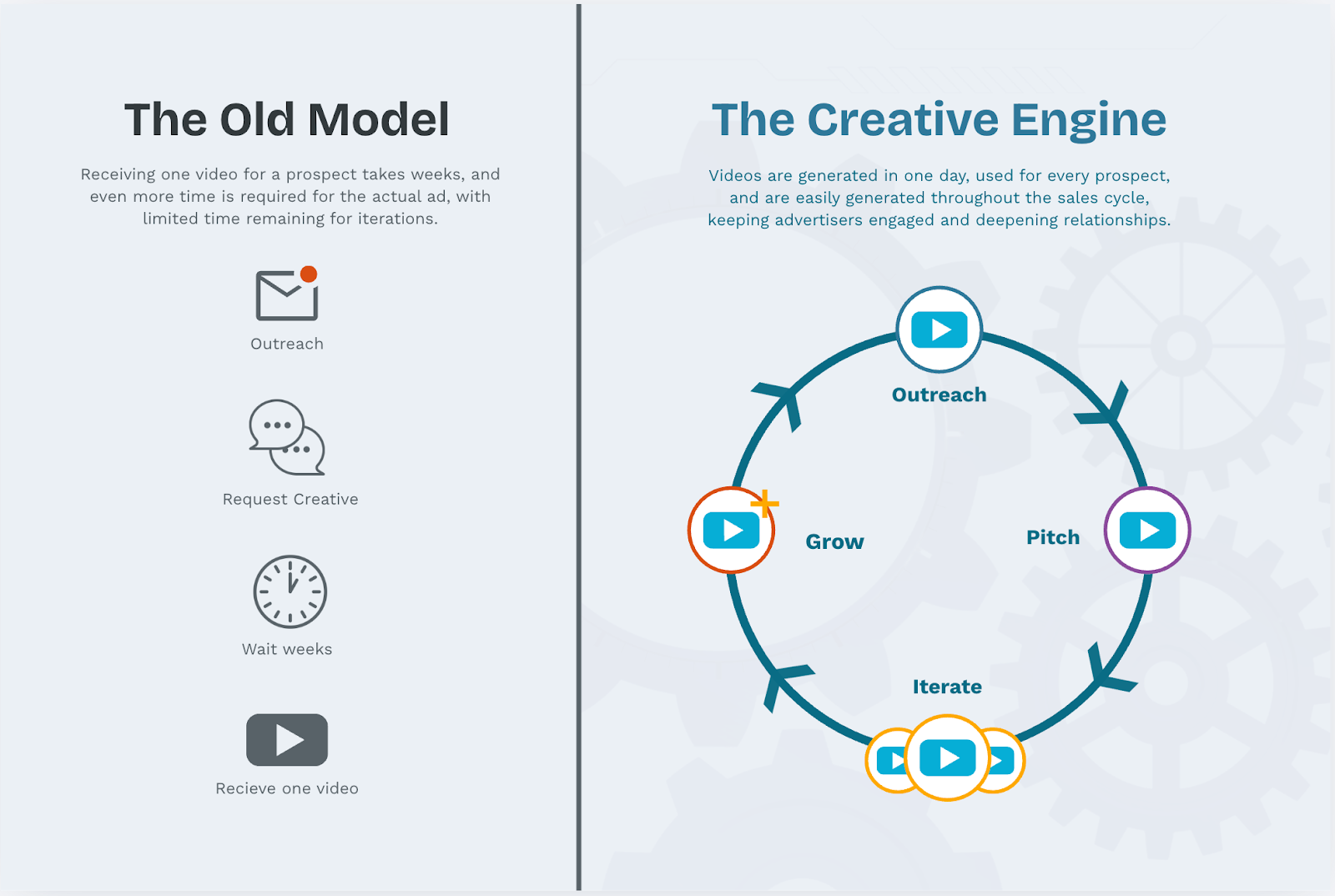
Most media sales organizations still treat creative as a production task. An advertiser expresses interest, the sales team submits a creative request, a producer or designer builds a spec spot, and the finished product arrives days or weeks later. Sometimes it's great. Sometimes it misses the mark. Either way, the process is the same: one request, one deliverable, one chance to make it land.
That model worked back when the sales pipeline was smaller and the competitive set was limited. But today, media sellers are competing for budgets against platforms that let advertisers launch campaigns in minutes. A local business owner can set up a Meta ad with a preview in the time it takes most broadcast or CTV sales teams to schedule a production call.
The math is also unforgiving. If a sales team has 200 prospects in the pipeline and can produce spec creative for ten of them per month, they're showing up empty-handed to 95% of their conversations. The rest get a rate slide and a promise.
The production bottleneck also limits when creative enters the conversation. When spec video is expensive and slow to produce, teams reserve it for prospects who are already leaning toward a buy. But the teams that have unlocked creative at scale are able to use spec video much earlier, including in the first cold outreach email, turning it into a preview of what’s possible. That’s only feasible when creative production doesn’t require a week of lead time and a dedicated producer.
Meanwhile, the advertisers that those teams are pitching have higher expectations than ever. They've seen what self-serve platforms can do. They expect to visualize their brand on the big screen before they commit, and they expect it to happen fast.

The shift isn't about working harder or hiring more producers. It's about changing the operating model from project-based production to a system that generates video creative at the speed of the sales pipeline.
A creative engine has a few defining characteristics that separate it from traditional production workflows:
Instead of treating every spec ad as a blank canvas, the strongest teams define one or two core creative platforms — narrative structures that work consistently across advertisers and categories. Something like "solve one real customer problem in thirty seconds" or "show one real local story." These platforms give AI and human creators a clear starting point rather than an open-ended brief.
Using existing brand assets — a URL, a logo, product images, brand guidelines — AI tools can generate script options, visual treatments, and voiceover drafts in minutes rather than days. Waymark can turn a single URL into a TV/CTV-ready spec ad, pulling in the advertiser’s branding, imagery, and messaging automatically.
This isn't about replacing creative judgment. It's about eliminating the blank-page problem and giving human leads something concrete to react to, refine, and elevate.
One core idea becomes multiple versions: different hooks for different audiences, different lengths for different placements, different calls to action for different stages of the funnel. Instead of one spec spot per prospect, the engine can generate a tailored preview for every qualified opportunity in the pipeline.
Every new “what if we did this” moment becomes an actionable idea and no longer needs to be tabled due to a lack of resources.
The best versions get selected, refined for brand voice and storytelling, and contextualized for the specific advertiser and placement. AI generates the volume; humans ensure the quality and consistency.
Teams record results by asking questions and collecting data after each output. Which creative frameworks perform best? Which hooks drive the most engagement? Which advertiser categories respond most strongly to spec previews? Over time, the engine learns and the hit rate improves. Teams start adapting proven patterns rather than starting from scratch every time.
Three converging forces make the creative engine model essential right now.
CTV inventory is exploding, but creative hasn't kept pace. Most viewers now watch TV through streaming bundles, FAST channels, and smart TV platforms. The average household used around ten video services last year. CTV buying has become more accessible and more programmatic. Buyers can now access linear and CTV inventory through the same interfaces they use for digital video. But the creative side of the equation hasn't evolved at the same speed.
Sellers have more inventory to fill, and more formats to support — and the advertisers who could fill that inventory often don't have CTV-ready creative. Smaller and mid-sized businesses, in particular, have the budgets to show up on CTV but lack the production resources to get there. Sales teams that solve their advertisers' creative problems will capture spend that would otherwise go to channels with lower barriers to entry.
The pitch is now a preview. Advertisers evaluating CTV increasingly expect to see what their campaign will look like before they commit. In Waymark's AI + CTV 2026 report, this dynamic was a consistent theme: the question is no longer whether brands can afford to create for CTV, but whether sellers can show them what's possible quickly enough to keep the conversation alive. A deck full of CPMs and audience segments just can’t compete with a finished preview featuring the advertiser's own brand, products, and messaging on a TV screen.
Measurement expectations are compressing the sales cycle. Buyers now expect CTV to prove its value the way digital channels do — with concrete metrics tied to business outcomes. As retail media and CTV increasingly intersect, some advertisers can already track how a streaming ad translates into product page views and purchases inside closed-loop systems. That means sales teams can't afford long lead times between initial pitch and campaign launch. Creative bottlenecks that add weeks to the process aren't just inconvenient — they're directly costing revenue. An engine that produces spec creative in hours instead of weeks keeps the momentum from the first meeting to signed IO.
Here's the part that should concern any media sales leader reading this: some teams are already operating with a creative engine. They're generating CTV-ready spec previews for every prospect in their pipeline, not just the top ten accounts. They're walking into meetings with a finished ad featuring the advertiser's brand, ready to play on the big screen. And they're closing faster because the advertiser can see the vision instead of imagining it.
Consider the difference from the advertiser's perspective:
In one meeting, a rep presents audience reach numbers, talks through packages, and describes what a campaign could look like. In the next meeting, a different rep plays a thirty-second spot on a screen — featuring the advertiser's own logo, products, and a tailored message. The second rep isn't just selling media; they're demonstrating a vision of what the advertiser's brand could look and feel like in a premium environment. That's an entirely different sales conversation.
The teams still operating on the old model — submit a request, wait for production, hope it lands — are losing deals to competitors who can show up with a preview on the first call. It's the same dynamic that played out in digital over the past decade. The platforms that made it easy to see your ad before you spent money won. The ones that asked buyers to commit based on a media plan alone lost ground.
CTV is now at that inflection point. The sales organizations that build creative engines will own the next era of media revenue. Those who keep treating video ad creative as a production line item will keep wondering why advertisers choose platforms with smaller premium audiences but faster, more visual buying experiences.
The media sales teams that will lead in 2026 aren't the ones with the best inventory or the lowest CPMs. They're the ones that solve the creative problem for their advertisers at the speed of the pipeline. They're the ones that turn every prospect conversation into a visual experience rather than a hypothetical one. And they're the ones building systems — not placing orders.
The creative engine isn't a nice-to-have. It's the new table stakes for media sales organizations that want to compete for the budgets moving to CTV.
For a deeper look at how AI and CTV are reshaping creative, measurement, and media sales in 2026, download the full AI + CTV in 2026 report.
Want to see what a creative engine looks like in practice? Try the interactive Waymark demo.
Get Started
With our instant setup and easy-to-use tools, the only thing you’ll miss is the frustration of traditional ad production.