Written by
Larissa McCarty
Published on
March 12, 2026
Blog Post
Trends
Ad-supported streaming platforms, retail media networks, and self-serve DSPs have spent years making it easier for advertisers to buy media on their own. The interfaces are faster. The targeting is sharper. The reporting is more transparent than ever.
But most of these platforms still have the same gap they had five years ago: the advertiser has to show up with finished creative, or they don’t run.
For every advertiser who arrives with a polished thirty-second spot ready to go, there are dozens more who have a media budget, a product to promote, and no video. The platforms that close this gap by embedding video creation directly into the buying experience will capture the ad spend that everyone else leaves sitting on the table.
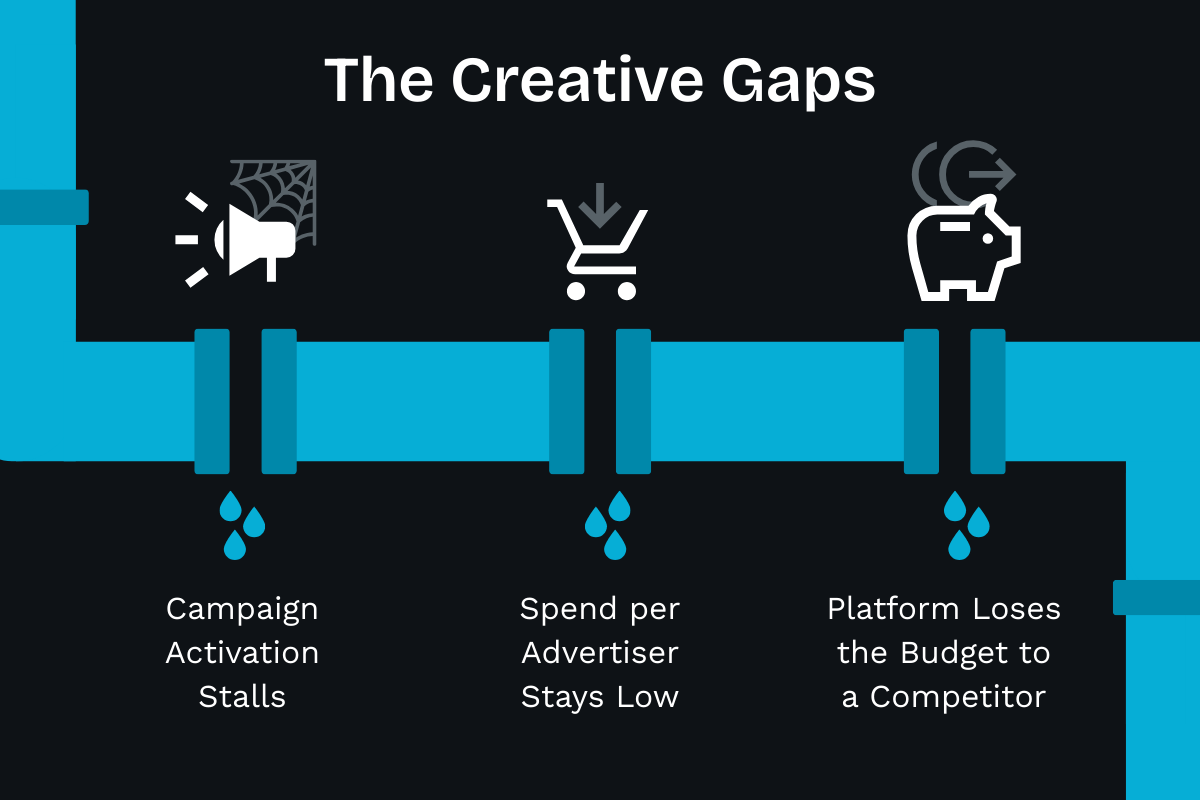
Platform leaders tend to frame creative friction in product terms like upload formats, spec requirements, and asset management. But the real issue is economic, and it shows up in three distinct ways.
First, campaign activation stalls. The advertiser sets up targeting, reviews inventory, and then hits a wall: they need a finished video. If they don’t already have one, the campaign sits in draft or gets abandoned entirely. Self-serve platforms track sign-ups and account creation religiously, but many have a significant drop-off between account setup and the first live campaign. Creative is often the reason.
Second, the spend per advertiser stays low. Without the ability to easily produce and iterate on creative, advertisers tend to run a single asset until it burns out and then pause. They don’t experiment with different messages for different audiences or refresh creative to fight fatigue. The platform captures a single flight of spending rather than an ongoing, growing relationship.
Third, the platform loses the budget to a competitor that makes creative easier. A local restaurant owner who wants to advertise on TV/CTV but doesn’t have a video will find it far simpler to launch a campaign on a social platform that can turn a few product photos into a video in minutes. The advertiser didn’t leave because the inventory was bad. They left because the creative barrier was too high.
None of these outcomes show up clearly in a product dashboard. They look like churn, low average revenue per user (ARPU), or slow ramp. But the root cause is often the same: the platform solved buying and forgot about making.
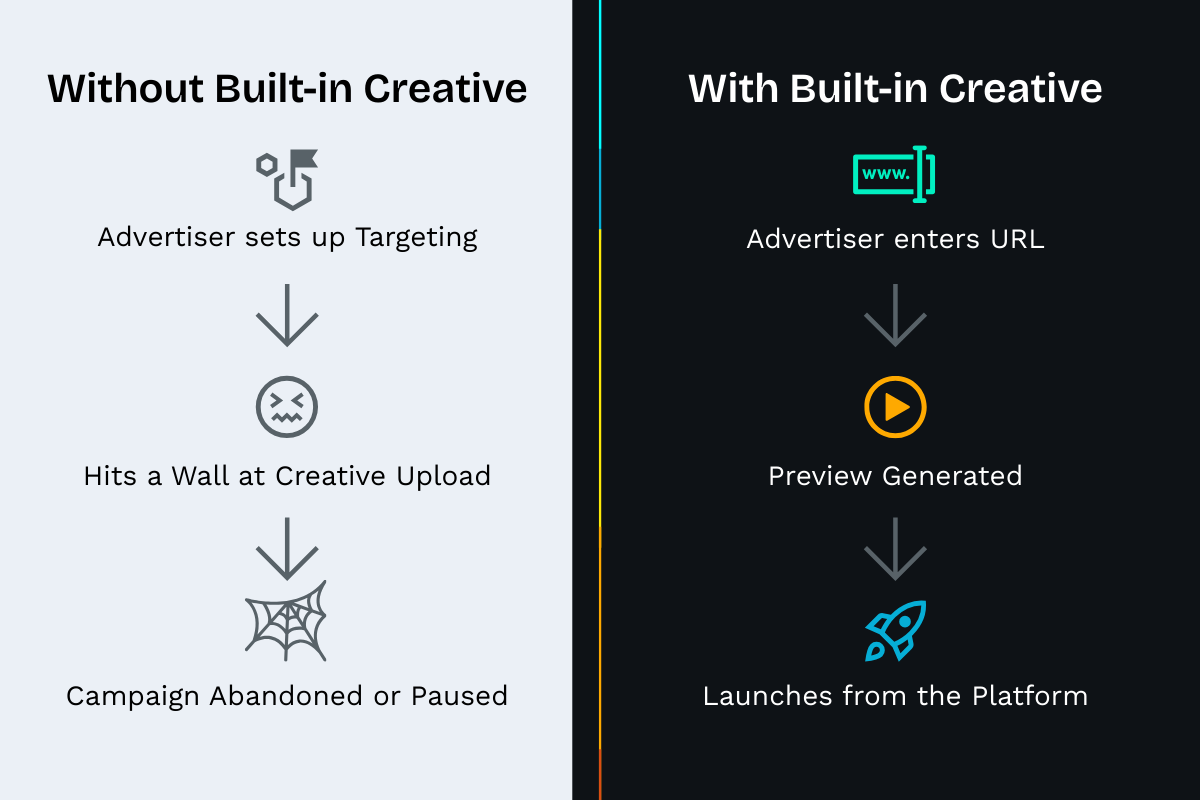
Platforms gaining ground in advertiser activation and retention are treating creative as part of the buying workflow — not a prerequisite. That shift varies by platform type, but the pattern remains consistent.
Instead of asking advertisers to upload a finished asset before launch, these platforms are integrating to enable them to build video directly within the campaign setup process. An advertiser can enter their website URL or brand name, and the platform will automatically generate a broadcast-quality video preview using existing brand assets, including logos, images, messaging, and color palettes.
The advertiser sees what their campaign will actually look like on a big screen before committing any budget, and once they’re satisfied, they can launch directly from the platform. That alone changes the conversion math. It moves creative from a barrier into a revenue driver.
This is exactly the kind of integration Waymark is built for. Waymark partners with platforms so their advertisers can create broadcast-quality video ads right inside the platform. No external production required, no handoff to a creative team. For platforms looking to close the gap between account creation and first live campaign, it’s a direct solution.
A single generated video is useful. But the real advantage comes when the platform can produce multiple versions of the same core idea — different hooks, different lengths, different CTAs — so advertisers can test what works and optimize without needing to go back-and-forth with a production team.
This is where AI-powered creative at the platform level shifts from a convenience feature to a genuine revenue driver. More creative variations mean more active campaigns, more testing, more spend, and longer advertiser lifetimes.
One of the legitimate concerns about embedding AI-generated creative into a platform is quality. If the output looks cheap or off-brand, it damages advertiser trust in the platform, not just in the creative tool. Platforms that get this right are incorporating technologies like Waymark, which automatically enforce brand safety and visual quality standards.
The creative stays within brand guidelines, uses professional-grade templates and visual treatments, and looks like it belongs on a TV screen alongside premium content. It’s less about generating quick-and-dirty assets and more focused on delivering broadcast-quality video at the speed self-serve advertisers expect.
The most valuable self-serve platforms are those that give advertisers a reason to come back when they want to launch a new campaign, refresh an existing one, or test a different message.
When creative production is built into the platform, it becomes a reason to stay, not just a way to get the first campaign live. Iteration becomes easy, and easy iteration compounds into a higher lifetime value per advertiser.
Three forces are converging to make embedded creative capability a competitive necessity rather than a nice-to-have:
Streaming bundles, FAST channels, and smart TV platforms have opened up enormous CTV inventory. Buying has become more accessible and more programmatic; buyers can now access CTV inventory through the same interfaces they use for digital video. But on the creative side, most advertisers, especially small and mid-sized businesses, still don’t have CTV-ready assets.
Platforms that solve this problem will capture the long tail of ad spend that has been locked out of the big screen.
A business owner running ads on Meta or Google expects to preview their creative, adjust it, and go live in minutes. That’s the baseline. When those same advertisers explore CTV, they expect a similar level of ease, and when they don’t find it, they disengage.
Platforms that force advertisers to bring finished video into a self-serve environment are fighting against a user expectation set by completely different channels.
As CTV measurement matures with tighter connections to CRM data, retail signals, and closed-loop attribution, advertisers are seeing which creative approaches actually drive outcomes. That visibility creates a natural demand for more testing, more variations, and faster creative cycles.
Platforms that can support that velocity will retain the advertisers who are optimizing. Platforms that can’t will watch them move to environments that make it easier to act on what the data is telling them.
The platforms that embed creative into the buying experience gain a compounding advantage.
Each campaign generates performance data that makes the next campaign’s creative smarter. Each advertiser that activates without needing external production proves the model works and brings more referrals and organic growth. Each creative refresh that happens within the platform, rather than being outsourced, strengthens the advertiser’s dependence on the ecosystem.
This mirrors the shift that already played out in social advertising over the past decade.
The platforms that made creative production part of the ad buying workflow dominated.
The platforms that expected advertisers to arrive with finished assets served a smaller, more sophisticated segment — and left the long tail of ad budgets to channels with lower barriers.
CTV is at that same inflection point. The question for platform leaders isn’t whether embedded creative matters; it’s whether they adopt the capability now, while the competitive window is still open, or cede that ground to the platforms that moved first.
Waymark integrates directly with ad platforms, so advertisers can create broadcast-quality video ads directly within the campaign setup experience. No production team, no outside tools, no dropped campaigns. If you’re a platform leader looking to increase advertiser activation, reduce churn, and drive more spend per account, Waymark is built for exactly that.
Read more about how Waymark works with platforms to increase usage.
Get our guide on how to win ad revenue by solving creative using the link below
Get Started
With our instant setup and easy-to-use tools, the only thing you’ll miss is the frustration of traditional ad production.